That boy is a monster-er-er-er-er-er

Updated: Sep 16
In “Leviticus,” monstrosity comes from bigotry and romance is in the resistance.

"It is true, we shall be monsters, cut off from all the world; but on that account we shall be more attached to one another". -Mary Shelley, Frankenstein
In her 2009 song, Lady Gaga is afraid her lover is a monster, ready to eat her heart. However, Judith Halberstam has a slightly different concern. In her study of gothic horror Skin Shows, Halberstam argues that monsters are “meaning machines.” Simply put, narratives about monsters rely on societal self-identification in relation to Otherness: the border between “normal” and "monstrous” is a reflection of a broader consensus on social values, as well as a place where social meaning is manufactured. The majority creates its own morality, not inherent as much as it is self-perpetuating, continuously manufactured in relation to the minority.
In Leviticus (2026), the experience of the artificially imposed Otherness is at times haunting and violent, represented through monstrosity and social alienation, but also a source of community, identification and intimacy.
The background
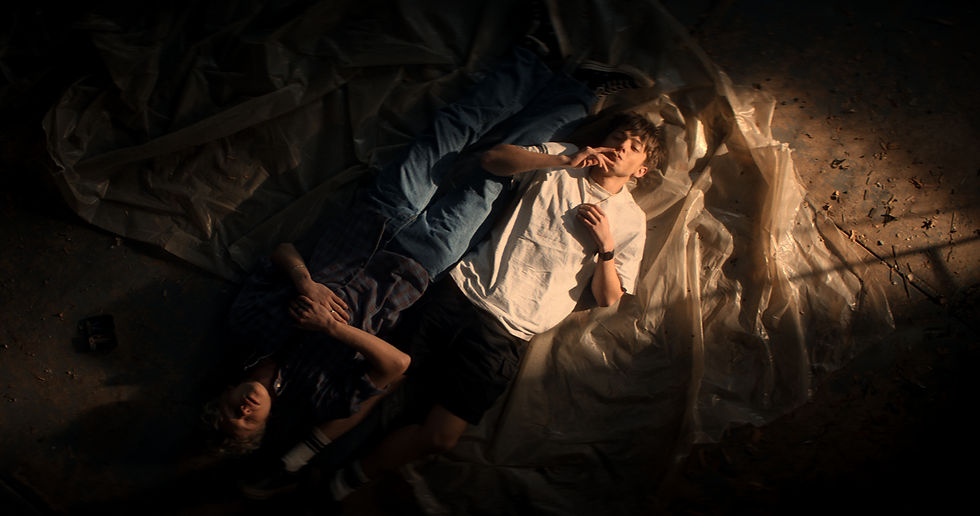
The coming-of-age horror film, written and directed by Adrian Chiarella in his feature directorial debut, is set in an isolated, hyper-religious evangelical Christian town in rural Victoria, Australia. Teenager Naim (Joe Bird), and his mother, Arlene (Mia Wasikowska) are newcomers to this hermetic community. After Naim and his classmate Ryan (Stacy Clausen) become romantically involved, and subsequently outed to their families and the church community, they undergo a ritual performed by a “deliverance healer”. A combination of a conversion therapy ritual and a gay exorcism of sorts, the procedure has a very important side effect: those who undergo it are haunted by a monstrous, violent entity that takes the shape of the person they like most. In a clear parable of religion-based homophobia, the entity follows the boys with a very clear intention: alienating them from each other through fear.
The entity only strikes its victims when they are alone. The logical solution, and the one the protagonists crave the most, is the one that is seemingly not an option - they cannot stick together, because they cannot trust each other. The entity convincingly takes the form of the other person, using their intimacy against them. After Hunter, one of their classmates who has undergone the same procedure is murdered by his own entity, Ryan and Naim need to fight to find a way to survive.

One of the most obvious cinematic precursors to Leviticus is It Follows (2014, David Robert Mitchell), centered on a young woman pursued by a supernatural entity after a non-consensual sexual encounter. In this case, the horror comes from an infringement on a woman’s bodily autonomy.
Similarly, esteemed Australian genre director Jennifer Kent, in her 2018 film The Nightingale, follows a young Irish convict in 19th-century Van Diemen’s Land. She joins forces with an Aboriginal Tasmanian tracker to get revenge against members of the colonial forces of Tasmania who violated her and killed her husband and daughter. Kent’s feature directorial debut, The Babadook (2014), explores grief through a story about a widowed single mother who has to confront a mysterious monster appearing in her home. Again, the monstrosity is a physical embodiment of grief, fear and loss.
A detail crucial to understanding Australian horror and the topics inherent to Australian cinema at large is the continent’s storied, colonial past and its relation to the so-called terra nullius doctrine.
Terra nullius, according to Neil Overton, is the Latin term for “land owned by no one”. Land that had not been occupied by Christians was considered vacant and only “discovered” after the colonialists moved onto these territories. This land has, in fact, been inhabited for centuries by the Indigenous people, but they did not “own” it according to European definitions of ownership. This semantic distinction was shamelessly used for a surface-level justification of centuries of colonial violence and subjugation. Films like Picnic at Hanging Rock (1975), and Long Weekend (1979), embody this deep-seated dread of the colonized land striking back, reflecting the fears and anxieties of the colonizer.
The concept of an empty, uninhabited natural landscape that is also profoundly difficult and inhospitable creates a sort of national anxiety that is a very convenient field for the development of horror cinema, especially when it pertains to themes of isolation, Christian nationalism, Western ideas of sovereignty and, of course, the deep-seated fear of retribution. The retribution could come not only from the natural landscape, but also the people who have been subjugated. A very clear benefit to having a strong religious, dogmatic justification for one’s way of life, perfectly ties into the evident predominance of evangelical Christianity in rural Australia.
The horror of queer desire
A very important part of the deeply entrenched Christian morality is, of course, the concept of the nuclear family and its rejection of homosexuality. As Kent Brintnall discusses in his paper Rebuilding Sodom and Gomorrah: The Monstrosity of Queer Desire in the Horror Film, Christianity has long had a very troubled relationship with sexual desire, as well as the body in more general terms. The title of the film references the Book of Leviticus, the third book of the Christian Old Testament, frequently cited as the Bible passage that condemns homosexuality most strongly.
"If a man lies with a male as with a woman, they have committed an abomination; the two of them shall be put to death; their bloodguilt is upon them." - Leviticus 20:13:
Since Christianity has been the predominant religious paradigm in the West, including the United States and the rest of the Anglosphere, popular entertainment also perpetuates this Christian rhetoric of sexual deviance. In the same way that the monster is constructed as the Other in relation to which the “normal” is constructed, sexual deviance is also constructed in opposition to “normality.” Queer desire is positioned as a sort of perversion, used rhetorically to further legitimize heteronormativity.
Even when the media does not entirely condone overtly hateful and homophobic religious rhetoric, general attitudes toward sexuality, especially in horror film tropes, very much betray the overreaching influence of Christian theology. For example, the convention in horror is that sexually experienced characters die first, while virgins, the “pure” ones, survive, especially for female characters interested in making it out alive (the infamous “final girl” trope).
In this regard, Leviticus still fits comfortably within the rising canon of “conversion therapy films.” But I'm a Cheerleader (1999) exposes the hypocrisy and absurdity of the practice, featuring Ru Paul as one of the “converted” camp counselors. On the other hand, in Boy Erased (2018, Joel Edgerton) and The Miseducation of Cameron Post (2018, Desiree Akhavan), conversion therapy is exposed as a fundamentally traumatic and dehumanizing practice with overarching consequences. These consequences are efficiently shown through the introduction of the monstrous entity in the folklore of Leviticus.
In the film, violence and the hypermasculine performance of violence are very often excuses for physical intimacy and are even established as precursors to it. Ryan and Hunter, the pastor’s son, who are established to have been engaging in some sort of relationship before Naim’s arrival, share intimacy under a veil of guilt, shame and violence. Their romantic connection is abrupt, erratic and inseparable from brutality. This dynamic starts as the basis for Ryan and Naim’s relationship.
However, after playful ribbing turns into not-so-playful, physically rough interactions, Naim surprises Ryan by approaching their romantic intimacy with an unexpected tenderness. As Naim tells him, “You’re so different when no one’s around.” Even before the entity, Ryan’s nature is dual: he is privately much more at peace with his own identity than he publicly lets on, forced to conform to the strict ideals of the unforgiving community. Naim disrupts the established repetitions by giving Ryan the permission he craves to be gentle.
The exorcism ritual itself identifies homosexual desire with lust. During the ritual, the healer calls for all their “lust, indecency and desire” to go away. Evangelical religious dogma does not look particularly fondly on any free expressions of sexuality, but finds homosexuality especially deviant or, in the words of Halberstam, engages in meaning-making by depicting it as monstrous.
Ultimately, the most impactful choice in Leviticus is the refusal to comply with the depictions of queerness as monstrous. Instead, the monstrosity comes from the outside - when internalized, the hatred threatens to destroy the protagonists from within. In the attempt to alienate Ryan and Naim from each other, the entity ultimately brings them even closer together. They are now united by a shared experience. It entails not only shared trauma but also shared joy: an emotional connection and identification based on mutual understanding.
When Naim’s mother is exposed as fully aware of the ramifications of the ritual, she doesn’t particularly care.
“They told me it would keep you safe,”
she says, adding:
“We need fear. That’s how we survive.”
In this sense, both Naim and Ryan are let down and left behind by all the adults in their lives and by their entire communities, which are not only leaving them exposed to danger, but actively working to instill fear in them. In the words of entity Ryan, clearly reflective of Real Ryan’s feelings:
“This is what they wanted: us to be scared of each other,” and “I was scared of how I felt about you.”
The revolutionary power of queer joy
Ultimately, the thing that makes the entity dangerous is its biggest weakness. It is very good at imitating the person it is pretending to be, down to their deepest affections. It exists to penalize sexual desire, but is left vulnerable to expressions of emotional intimacy and tenderness: for instance, entity Ryan hesitates for a second, after Naim gently caresses his face.
The path toward deliverance for the protagonists is therefore a path of self-acceptance. This includes accepting romantic intimacy hand in hand with sexual desire, with neither of them being understood as lesser. Their friend Hunter dies first, unable to fight the entity, not because he was, in accordance with traditional horror tropes, the most promiscuous one, but because he is the one with the most self-loathing and internalized homophobia. A pivotal scene, and one of the few unequivocally happy moments for the couple depicts them “consummating” their relationship, hinting at the joy and the freedom enjoyed when desire, particularly queer desire, is not demonized as sinful and dangerous.
As Brintnall notes, there is something “potentially liberating and empowering about being a source of fear [and] anxiety.”
He asks:
“Can we revel in our marginality as a psychic fund for resistance instead of internalizing it as a badge of shame?” (p.14)
This point of view is what makes Leviticus a particularly poignant and compelling exploration of both religious repression and queer liberation.
The only way for Naim and Ryan to move forward is to lean into each other, but also to lean into who they are. As Ryan says in the most romantic line of the film, "If I'm going to live with this thing, .... I want it to look like you." The tragedy of the setup stems from the same place as the romance. The entity exposes and weaponizes people’s deepest desires and affections. The result is bittersweet: the joy of knowing for certain that your crush likes you back, comes with knowing this very fact could be your demise.
As Bob Marley and the Wailers sing in “Running Away,” “You’re running and you’re running and you’re running away, but you can’t run away from yourself.” In this sense, deliverance for them is in self-acceptance, which for Naim and Ryan entails leaving their hateful hometown in order to experience a bigger, more loving world. Are the monsters going to follow them, as long as they have any inkling of internalized homophobia? Or, are they being left behind, within the city limits of the deeply intolerant town? We don’t know for sure.
What we do know is that peace is often found in acceptance, and self-love, just like community, is built in relation to others. The beating heart of this earnest and intelligent film and the epicenter of its romance is the terrifying but exhilarating ordeal of being known and accepted, not despite who you are, but because of it. In the face of hatred, grief and betrayal, there is a light at the end of the tunnel for Naim and Ryan. There is joy to be found in freedom. It is a joy that they yearn to freely share.
Watch list:
It Follows (2014, David Robert Mitchell)
The Nightingale (2018, Jennifer Kent), The Babadook (2014, Jennifer Kent)
Picnic at Hanging Rock (1975, Peter Weir), and Long Weekend (1979, Colin Eggleston)
But I'm a Cheerleader (1999, Jamie Babbit)
Boy Erased (2018, Joel Edgerton)
The Miseducation of Cameron Post (2018, Desiree Akhavan)
Sources:
Rayner, J., 2022. Australian gothic: A cinema of horrors. University of Wales Press.
Overton, N., 2016. Land is (land): Australian film lore. Fusion Journal, (10), pp.462-515.
Shah, S., 2023. The doctrine of discovery and terra nullius. The Indigenous Foundation.
Culley, N., 2020. The isolation at the heart of Australian horror. Kill Your Darlings, pp.263-265.
Overton, N., 2016. Land is (land): Australian film lore. Fusion Journal, (10), pp.462-515.


Comments